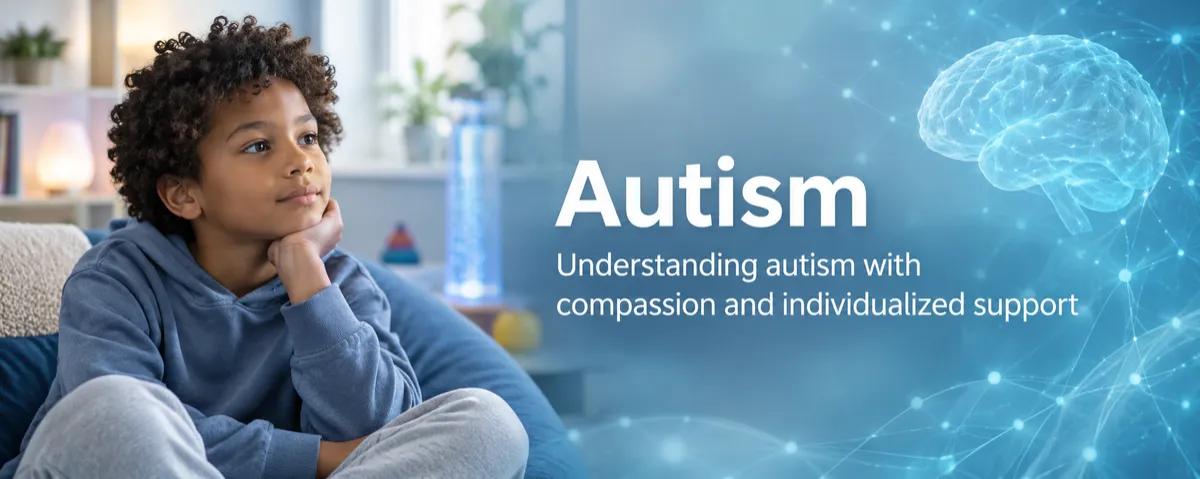
Autism
Autism is a neurodevelopmental condition that influences how a person experiences the world, communicates, interacts with others, and processes sensory information.
It is not an illness that needs to be erased. Autism reflects differences in brain development that can shape how individuals think, learn, communicate, and respond to their environment.
How Autism Can Show Up
Autism presents differently in every individual. Some common characteristics may include:
Differences in social communication: Difficulty interpreting social cues, understanding nonverbal communication, or navigating social interactions.
Repetitive behaviours or routines: Repeating certain movements, preferring predictable routines, or experiencing distress when plans change.
Sensory sensitivities: Being unusually sensitive to sounds, lights, textures, smells, or touch, or seeking particular sensory experiences.
Focused interests: Developing deep, sustained interests in specific subjects, activities, or objects.
Differences in emotional regulation: Experiencing emotions intensely or needing additional time and support to process overwhelming situations.
Differences in learning and information processing: Having unique ways of understanding, organizing, or responding to information.
Autism exists on a spectrum. Every autistic person has a different combination of characteristics, abilities, and support needs. Not every person will experience all these characteristics.
Understanding Autism Through a Brain-Based Lens
Autism is associated with differences in brain development and how the brain processes social information, sensory input, communication, and patterns in the environment.
These differences can influence how a person responds to everyday experiences. For some individuals, busy environments, unexpected changes, or complex social situations may become overwhelming. Others may thrive with structure, clear communication, and opportunities to engage deeply with their interests.
Understanding these experiences through a neuroscience-informed perspective can help identify individual needs, recognize strengths, and guide appropriate support.
Autism is not caused by poor parenting, and it is not something a person develops simply because of stress or emotional experiences.
Our Approach to Autism Assessment and Support
You do not need to know exactly what kind of support is needed before beginning the process.
Care starts with a comprehensive, individualized evaluation designed to better understand the person's developmental history, current experiences, strengths, and challenges.
Depending on the individual's needs, this may include:
Developmental and clinical history
Assessment of communication, social interaction, and behavioural patterns
Review of sensory experiences, emotional regulation, and daily functioning
Consideration of co-occurring conditions, where clinically appropriate
Discussion of personal, family, educational, or occupational support needs
Support plans are individualized and may include psychoeducation, appropriate therapies, occupational therapy, communication support, family guidance, or psychiatric care when indicated. Recommendations are based on the individual's needs, goals, and clinical assessment.
Supporting the Person, Not Just the Diagnosis
Understanding autism goes beyond identifying characteristics. It means recognizing the individual behind the diagnosis, respecting their differences, building on their strengths, and providing support that helps them navigate daily life with greater confidence and well-being.
At Neuroscience Psychiatry, our goal is to help individuals and families better understand autism and explore appropriate pathways to support.
Getting Started
Need Answers?
Frequently Asked Questions to General questions
Who is Neuroscience Pscyhiatry for?
Neuroscience Pscyhiatry provides BOTH online mental health care to individuals 10 years and older. Our expert providers can help with anxiety, depression, and many other common concerns. We offer psychiatry, therapy, and Neuroscience Therapy.
Online care is not a good fit for people with certain conditions or situations. These can include:
1. Ongoing, high-risk self-harm behavior
2. Schizophrenia or any symptoms of psychosis
3. Some cases of bipolar disorder I or acute mania
4. Severe substance use
5. Medically unstable eating disorders
6. Dementia
If any of these describe a condition you’re experiencing, it’s best for you to be seen in person by a primary care provider who can help you find the treatment that’s right for you.
How Care at Neuroscience Psychiatry Works
1. Start with your a consultation with our consultant
Haven't seen us before? Start with a free 15-minute consultation to find the right care for you.
2. Schedule your comprehensive evaluation
Your first appointment is a deep-dive, not a rushed intake. Depending on your needs, this may include:
* A full psychiatric evaluation
* Optional brain mapping or neuroscience-based testing
* A review of your history, goals, and lifestyle factors
Together, we’ll uncover what’s driving your symptoms and create a plan that fits you—not just a prescription.
3. Get your personalized recommendations
Based on your evaluation, your provider may recommend:
* Psychiatry and medication management (when helpful)
* Therapy, mindfulness, or clinical hypnotherapy
* Neuroscience therapies like brain mapping, neurostimulation, or TMS
You’ll know exactly why each recommendation was made, and how it supports your brain and body.
4. Follow your plan, with ongoing support
Care doesn’t stop after your first visit. You’ll meet with your provider regularly to track progress, fine-tune your plan, and celebrate wins. Between sessions, you’ll have access to check-ins, guided tools, and self-tracking exercises to help you stay on course.
5. Track your progress and evolve
We measure what matters—your real improvements. With ongoing feedback, your provider adjusts your care so you continue moving toward balance, focus, and resilience.
Do you take insurance?
Yes, learn more about insurance we accept here.
Is my information kept private?
Neuroscience Pscyhiatry and its associated platform is HIPAA compliant and follows all HIPAA requirements including, but not limited to, the Privacy Rule. We encrypt data in transit and at rest. All communication with our software is done using signatures with a cryptographic hash algorithm. As well, all information is encrypted at rest once stored on our servers.
Why do you need to monitor my symptoms?
Mental health conditions are complicated. To make sure you are on the right treatment, and making appropriate progress, we will ask you to complete check-ins periodically to let us know how you’re doing. Your provider will review these check-ins to help them decide whether making an adjustment will help you get better, faster, and stay that way longer. You can also use this information to track your own progress over time.
How do I get my medication?
If prescribed, your psychiatric provider can send your prescription to a local pharmacy for your convenience.
How can I get help if I’m in crisis?
Your safety is extremely important to us. If you’re at immediate risk of suicide or self-harm, seek 24/7 help now:
1. Call or text 988 for the 988 Lifeline.
2. Call 911 for emergency support.
3. Go to your local hospital immediately for care.
Help is always available. We also recommend reaching out to a family member or friend to let them know that you are having these thoughts and to ask for help and support.
What do you treat?
Our expert providers can help with anxiety, depression, panic, suicidal thoughts, and many other common concerns, including:
1. Generalized anxiety disorder
2. Major depressive disorder
3. Panic disorder
4. Phobia
5. Social anxiety disorder
6. Obsessive compulsive disorder (OCD)
7. Post-traumatic stress disorder (PTSD)
8. Seasonal affective disorder (SAD)
9. Postpartum depression
10. Premenstrual dysphoric disorder (PMDD)
11. Insomnia
12. Bipolar disorder
13. And more

We’re committed to delivering life-changing depression, anxiety, and trauma care to everyone who needs it.
What We Offer
Who We Are
Our Care
Legal
© 2026 Neuroscience Psychiatry & Integrative Wellness PLLC